You can spot an AI commercial in three seconds. The skin looks dipped in wax. The camera drifts like it is dreaming. Everything glows for no reason. It is technically impressive and emotionally empty, a tech demo wearing a brand’s clothes.
The problem is not the tool. The tool is remarkable. The problem is how most people direct it. They prompt like engineers showing off what the model can do, instead of like filmmakers serving an idea. An AI commercial looks like AI when it is built to prove AI works. It stops looking like AI when it is built to sell the product.
We make AI commercials at Screenix. Spec films for eyewear, fragrance, fashion, made with no brief, just to see how far the craft can go. Every one of them taught us the same lesson: the audience does not care how the film was made. They care whether it feels real. Real is a series of decisions, and most of them have nothing to do with which model you used.
Why the average AI commercial gives itself away
Watch a dozen AI commercials back to back and a pattern appears. They all make the same five mistakes, and each one is a choice, not a limitation of the technology.
First, the physics are wrong. Liquid pours upward. Fabric moves like it is underwater. A watch strap bends in a way leather never bends. The viewer’s brain runs a physics check on everything it sees, and it does this check faster than conscious thought. One wrong movement and the spell breaks.
Second, the light has no source. In a real commercial, every highlight answers a question: where is the lamp, where is the window, where is the sun. In a lazy AI commercial, things glow because glowing looks premium. Glow without a source reads as fake instantly, because the eye knows light always comes from somewhere.
Third, the camera never commits. AI cameras love to drift, slow push-ins that go nowhere, orbits around nothing. Real directors move the camera with intention: to reveal, to isolate, to build pressure. A camera that wanders is a camera with nothing to say.
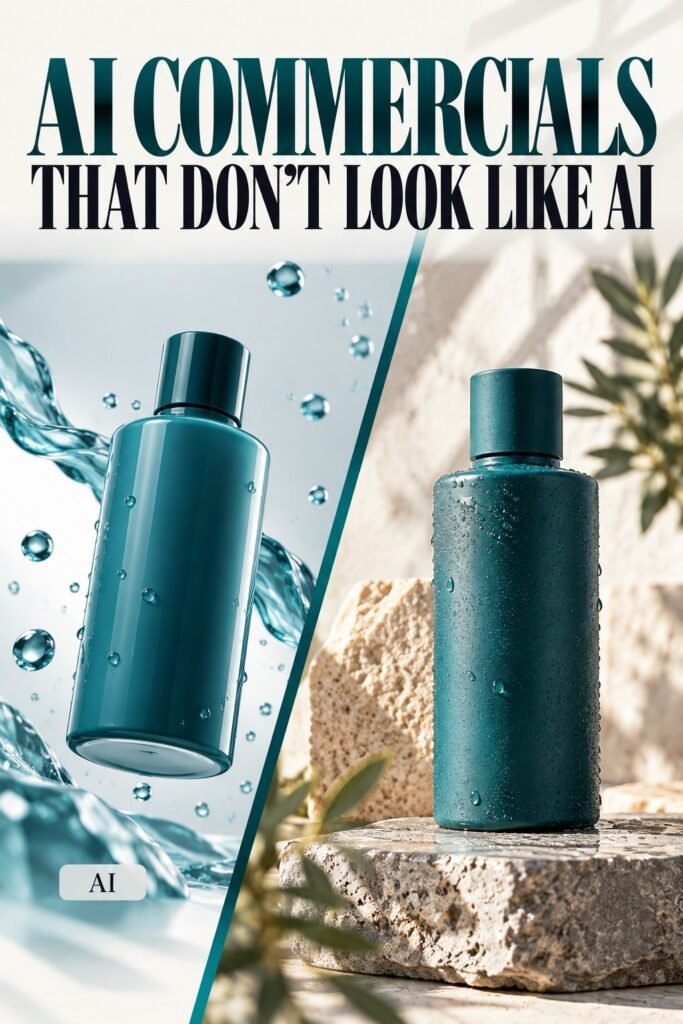
Fourth, everything is too perfect. Real film has grain, slight softness, a background that is a little messy. AI renders tend toward the hyper-clean, every surface polished, every edge crisp. Perfection is the uncanny valley of product film. The eye trusts texture more than it trusts polish.
Fifth, and this is the big one, there is no real product. The AI invents the bottle, the label, the stitching. Anyone who knows the product spots the lie in a frame. An AI commercial that fakes the product is not a commercial. It is fan fiction.
The Tell Test: five checks before you ship
Run every AI commercial through this test before it goes anywhere. If it fails any check, fix the check, not the prompt.
The physics check. Play it muted at half speed. Does anything move in a way the real world would not allow? Pour, fold, swing, splash, all of it has to obey gravity, friction, and weight. If a shot fails, cut it or rebuild it around a movement you can art-direct precisely.
The light-source check. Pause on any beauty shot and ask: where is the light coming from? If you cannot point to it, the audience cannot feel it. Rebuild the shot with one motivated source, a window, a lamp, a shaft of sun, and let everything else fall off into shadow. One honest light beats five pretty ones.
The camera-intent check. For every move, finish this sentence: the camera moves because ___. If the honest ending is “because it looks cinematic,” cut the move. Stillness is a valid choice. Most of the best product shots in film history barely move at all.
The texture check. Zoom into a still frame at 100 percent. Does the surface have grain, pores, weave, brushed metal, anything a finger would feel? If it looks airbrushed, add imperfection deliberately: film grain, a fingerprint on the glass, dust in the light shaft. Texture is what tells the eye “this exists.”
The product-truth check. Put the AI frame next to a real photo of the product. Label, proportions, materials, colors. If they do not match, the film is lying about the thing it is selling. This one is non-negotiable. We build our AI films around the client’s real packaging, never an AI-regenerated label, because the moment a customer compares the ad to the shelf and sees a stranger, trust is gone.
Five passes. Most AI commercials fail at least three.
What we do instead
Our process for an AI commercial starts where a traditional shoot starts: with the product on a table. We photograph it, study how light actually behaves on its surfaces, and lock the label, the proportions, the materials as unchangeable facts. The AI is then directed inside those facts, not instead of them.
We art-direct like the AI is a very fast, very literal junior. It does exactly what you describe and nothing you imply. So we describe everything: the exact lens behavior, the exact light source, the exact movement, the exact texture. Vague prompts get dream footage. Precise prompts get film.
And we edit like skeptics. Every shot has to earn its place by serving the idea, not by showing off the render. Some of our favorite shots from AI films are the simplest ones: a bottle sitting still while light moves across it. The tool wants to be spectacular. The director’s job is to make it be honest.
This is also why our AI work sits comfortably next to our traditional product films. Same bar, same process, different camera. The audience should never be able to tell which is which. That is the whole game.
The honest footnote
There is one case where looking like AI is fine: when the concept is about AI. A spot for an AI product can lean into the synthetic aesthetic deliberately, the way sci-fi leans into its own look. But that is a choice, with a reason, serving an idea. The failure mode is the default look happening by accident, because nobody art-directed against it.
The tool will keep getting better. The tells will get subtler. But the principle will not change: an AI commercial feels real when every decision serves the product and the idea, and it feels fake the moment it starts serving the technology. Direct the idea, not the demo.
Talk to us
If you have a product that deserves a launch film and a budget that deserves respect, talk to us. We will tell you honestly whether AI is the right camera for it, and if it is, we will make sure nobody can tell.