
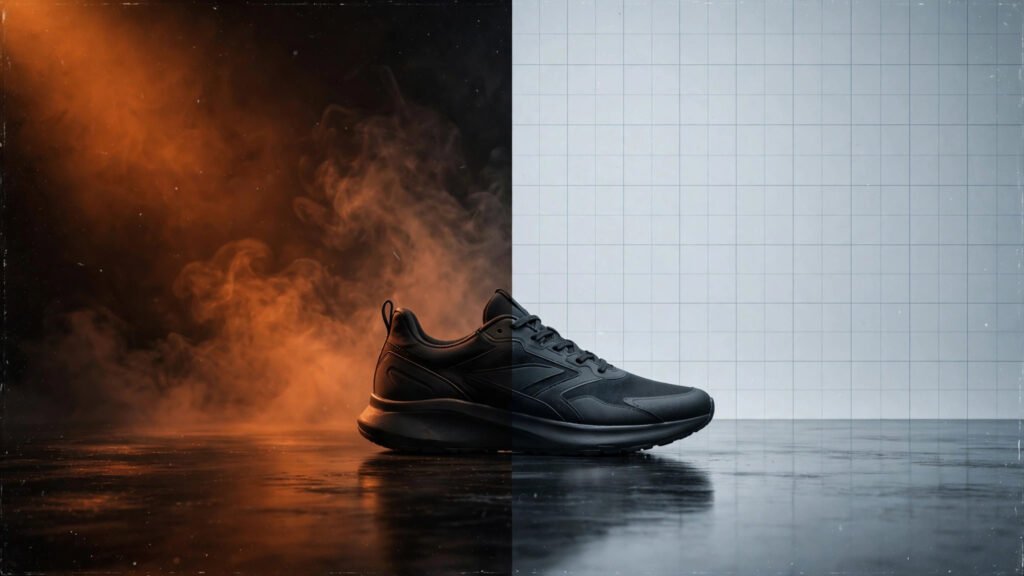
Most product video production starts with a brief that reads like a checklist. Show the features. Show the angles. Show it in use. Keep it clean. Thirty seconds. Done.
What comes back is perfectly competent and completely forgettable. It informs everyone and moves no one. Most brands do not have a product film problem. They have a product video problem, and they do not know the difference.
Here is the difference that matters. A product video explains the product. A product film makes you want it. One answers questions, the other creates desire. Confuse the two and you spend film money on a video, or video effort on a film, and the result changes nothing.
A product video answers questions. A product film creates desire.
A product video is built for someone who is already interested. They are on your page, they are comparing options, and they want to know: what does it look like, how does it work, what is in the box. The video answers, clearly and efficiently. That is a genuinely useful job, and plenty of brands need it done well.
A product film is built for someone who is not interested yet. They are scrolling, half paying attention, and they have no questions about your product, because they did not know it existed thirty seconds ago. You cannot answer questions they do not have. You have to give them a reason to care.
That is the real split. Videos serve demand that already exists. Films create demand where there was none. Our product film work lives on the second side of that line, in the business of making a stranger feel something about a product inside the first three seconds.
Notice what a film actually sells. It almost never sells the product itself. It sells the morning the product fits into, the person the buyer becomes with it, the small upgrade to an ordinary day. The product appears, but the feeling arrives first. A video does the reverse. The product arrives first, and the feeling, if it shows up at all, is an accident.
The craft differs too. A video is lit to be legible. A film is lit to be felt. A video uses music to fill silence. A film uses sound design to build a world around thirty seconds of footage. These are not decoration choices. They are structural ones, downstream of a single decision: are we informing someone, or are we moving them.
Neither is wrong. They are different tools for different moments. The trouble starts when a brand only owns one of them and expects it to do both jobs.
What product video production gets wrong most of the time
Scroll any marketplace and watch the product content. It all looks the same. White background, slow rotation, feature callouts sliding in, a cheerful track underneath, a voiceover reading the box. Clean, professional, and interchangeable. Your product is not interchangeable.
Part of the blame sits with the brief. Checklists are easy to approve. Nobody ever got fired for asking to “show the features,” so the brief keeps getting written the same way, and the output keeps looking the same way. The checklist brief is a procurement mindset applied to a persuasion problem. It optimizes for coverage, not for impact, and coverage is how you end up with a film that says everything and lands nothing.
But the deeper mistake is not how these videos look. It is where they get used. Brands take a video built to answer questions and push it into the feed like a film, then wonder why nobody stops scrolling. A video cannot create demand. It was never built for that. It assumes interest, and the feed has no interest to assume.
Then the wrong conclusion gets drawn: video does not work for us. What does not work is the wrong tool in the wrong place. A spec sheet does not work as a first impression either, but nobody blames the spec sheet. They blame the placement.
There is a second, quieter failure. Brands that sense the difference try to film-ify their videos with surface tricks. Moodier lighting, a slower song, a cinematic crop. None of that makes a film. A film is not a look, it is a structure. It has a point of view, a small story, a reason this product matters to someone specific. You can shoot a feature rundown in golden hour and it is still a feature rundown. The audience can tell, even if they cannot explain why.
So the question is not whether your product content looks good. It is whether it was built to create desire or to answer questions, and whether you are honest about which one you made.
Where each one earns its place
Films belong where attention is scarce. The launch. The ad. The social feed. Anywhere you have to earn the first three seconds from a stranger. This is also where a launch film starts to overlap with a commercial, because a great product launch is really a commercial with the product as the hero. Same job, same ruthlessness about the idea.
Videos belong where attention is already won. The product page. The FAQ section. The walkthrough a buyer watches after they have shortlisted you. Here the viewer has real questions, and the video’s job is to answer them so well that buying feels obvious. A clear, honest, well shot video on the product page will outsell a beautiful film buried there every time, because it meets the buyer where they actually are.
The smartest brands run both, in sequence. The film makes the stranger care. The video closes the sale. One creates the desire, the other removes the doubt. Cut either half and the funnel leaks. All desire and no answers means curiosity with nowhere to land. All answers and no desire means a perfect explanation nobody ever watches.
Repurposing follows the same logic. Cut the film down into shorter versions for the feed, and every cutdown still carries the original desire, because it was built in from the first frame. Try to stretch a product page video into an ad and it falls apart, because there was no desire in it to begin with. Desire scales down. Information does not scale up.
Here is a practical rule. If the placement is somewhere people chose to look at products, ship the video. If the placement is somewhere people chose to look at anything else, ship the film.
The Desire Test
Before you approve any product content, run it through one question. Show it to someone who does not need your product, someone with no reason to care, and watch their face.
If they lean in, if they ask where to get it, if they keep watching after it ends, you made a film. It created desire in a person who had none. That is the whole game.
If they nod politely and say “cool, what does it do,” you made a video. That is fine, as long as you know it. Put it on the product page, where “what does it do” is exactly the question being asked.
The expensive mistake is not making the wrong one. It is mislabeling. Spending film money to distribute a video, boosting a feature rundown into the feed and hoping for desire, is how budgets evaporate. Burying a real film on a product page, where only the already convinced will ever find it, is how great work goes unseen.
So ask the question early, in the brief, before a single frame is shot. Are we creating desire, or answering questions? One sentence. If the team cannot answer it, the content will try to do both, and content that tries to do both does neither.
A product video production plan that starts with that sentence is already ahead of most of the internet. Everything after it gets easier. The script, the shoot, the edit, every decision now has a test to pass. Does this create desire, or does this answer a question? Keep what serves the answer you chose. Cut the rest.
Your product deserves both, in the right order, in the right place. The film that makes strangers care, then the video that makes buyers certain.
When you are ready for the film half, talk to us. Desire is what we do.